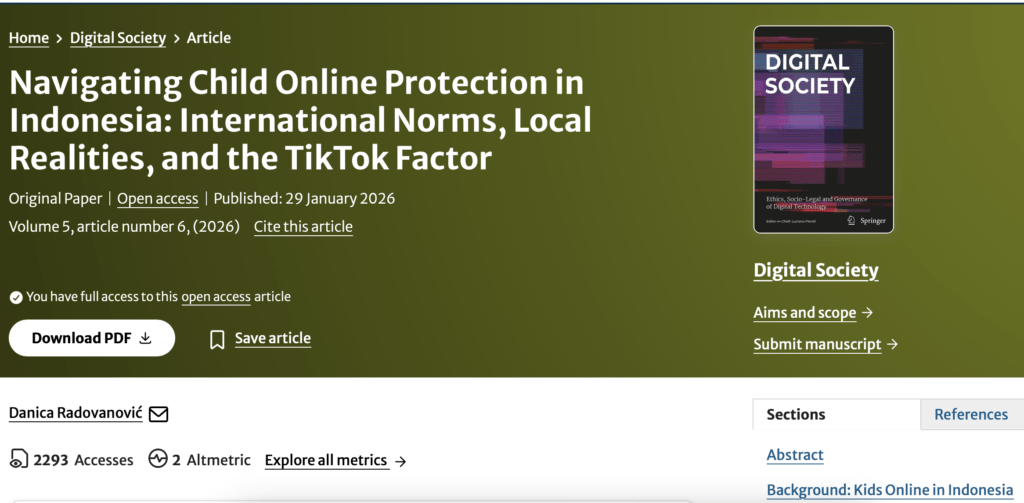
I’m pleased to share that my peer-reviewed paper, “Navigating Child Online Protection in Indonesia: International Norms, Local Realities, and the TikTok Factor,” has been published in Digital Society (Springer Nature).
The paper explores how global child online protection (COP) frameworks interact with local political, cultural, and regulatory realities in Southeast Asia, and how platform dynamics, particularly TikTok, reshape the governance landscape.
A central argument is that international digital governance models do not travel intact. Norms are interpreted, negotiated, and reconfigured within specific institutional and geopolitical contexts.
The research builds on several years of engagement at the intersection of development policy and digital governance, including work on child online protection initiatives including collaboration with the International Telecommunication Union (ITU), particularly the ITU Regional Office for Asia and the Pacific.
The research identifies several structural challenges. First, there is a persistent gap between international normative frameworks and national enforcement mechanisms. Second, platform governance remains largely driven by corporate self-regulation, with limited transparency and accountability. Third, child online protection policies frequently lag behind rapidly evolving platform features and monetization models.
In response, the paper proposes a set of policy recommendations aimed at policymakers and regulators. These include strengthening regional cooperation, investing in institutional capacity building, improving data access for regulators, and developing child-centered risk assessment models that reflect local realities rather than imported assumptions.
The emphasis is less on new rules, and more on making existing frameworks operational and enforceable.
Most importantly, the research argues for moving beyond universal templates. Effective digital governance requires contextual adaptation, continuous dialogue with local stakeholders, and a clear recognition of power asymmetries between states, platforms, and users.
Without this, child online protection risks remaining a formal commitment rather than a lived reality.
The full article is available open access here: https://link.springer.com/article/10.1007/s44206-025-00244-0